Start Racing
Objective & Prerequisites
The aim of the Start Racing course is to confidently introduce you to racing series and develop your skills and knowledge to a level where you can comfortably race at club and inter-club level in Ireland.
Upon successful completion of this level, sailors should be capable of competing in any club event, including the club's normal adult racing events.
To Pass the Course:
- Previous Experience: You must have completed the Improving Skills certificate.
- Time Commitment: A minimum of 28 hours (4 days) of Instructor-led time is required to cover all skills.
- Logbook Requirement: You must record at least 20 hours in your logbook.
- Mandatory Racing Logs: To achieve certification, you must log:
- Three (3) local/club races as helm.
- Three (3) local/club races as crew.
- Evaluation: Assessment is continuous, and you are expected to independently tune your boat, start and finish club-level races, and show understanding of basic rules, weather shift, tactics, and instruction from the Race Officer.
Regatta & Personal Preparation: Race Readiness
Successful racing starts on shore. You must master the preparation stages for both your boat and yourself.
Accessing Race Information
Before entering any race or regatta, you need to know where and how to get the essential information:
- Notice of Race (NOR): The NOR is the key document advertising the regatta. Find it on:
- The organizing club's website
- Irish Sailing's event calendar (www.sailing.ie)
- Class association websites
- Noticeboards at sailing clubs
- Email communications from your sailing club or class association
Interpreting the Notice of Race
Once you have the NOR, you must extract key information to plan your participation:
- Date of Regatta: Note the specific dates the regatta takes place, including any practice/briefing days.
- Number of Races: Check how many races are scheduled. This helps you prepare physically and mentally (e.g., "Up to 6 races over 2 days").
- How to Enter:
- Entry method: Online form, email, or in-person registration
- Entry deadline: Don't miss it!
- Late entry provisions: Some events allow late entries with additional fees
- Entry Fees: Note the cost and payment methods accepted (online payment, cash, cheque).
- Signing In: Check if on-site registration or sign-in is required on race day, and where/when this happens.
- Start Times:
- First warning signal time (when racing begins)
- Your class start time (if multiple classes racing)
- Subsequent race start times
- Latest time to start: Important for planning travel
- Other Important Details: Eligibility requirements, required safety equipment, location/venue, launching facilities, social events, and contact information.
Boat Preparation: Pre-Race Checks
Proper boat preparation ensures safety, legality, and optimal performance. You must be able to conduct comprehensive checks:
Hull Inspection:
- Check for cracks, damage, or soft spots in the hull and deck
- Inspect rudder and tiller for wear, cracks, or loose fittings
- Ensure centreboard/daggerboard moves freely and pintles/retaining systems work properly
- Check buoyancy tanks are intact and sealed (no water inside)
- Ensure drain bungs are secure and self-bailers function correctly
- Verify boat complies with class measurement rules (if applicable)
Rigging Inspection:
- Mast and Boom: Check for cracks, bends, or corrosion. Ensure all fittings are tight.
- Standing Rigging: Inspect shrouds and forestay for broken strands, wear, or corrosion. Check all pins and shackles.
- Running Rigging: Examine halyards, sheets, and control lines for wear, especially where they pass through blocks or cleats. Replace if frayed.
- Blocks and Fittings: Ensure blocks spin freely, shackles are secure, and cleats hold firmly.
- Sails: Check for tears, worn stitching, or damage to battens. Ensure sail numbers are clearly displayed and meet class rules.
Ensuring Sufficient Adjustability in Boat Controls:
Racing demands precise control. You must verify that all control systems have appropriate range and adjustment:
- Mainsheet System: Can you ease and trim the mainsheet smoothly through its full range? Blocks should run freely, and there should be sufficient purchase (mechanical advantage) for the conditions.
- Jib Sheet System: Check that jib sheets can be adjusted quickly and have adequate length. Ensure fairleads are positioned correctly for upwind and reaching.
- Cunningham/Downhaul: Verify you can tension and release this control to adjust luff tension. Important for depowering in strong winds.
- Outhaul: Ensure you can adjust foot tension on the boom. Tight for upwind, eased for downwind.
- Vang/Kicking Strap: Check the vang has enough power to control boom height and leech tension. Must be adjustable under load.
- Centerboard/Daggerboard Controls: Ensure the board can be raised and lowered easily and locks securely at different positions.
- Jib Fairlead Position: Confirm fairleads can be moved fore/aft (if adjustable) and are set correctly for the conditions.
- Traveler (if fitted): Check the traveler moves smoothly across its track and can be cleated securely.
- Test All Systems: Before launching, pull every control through its full range to ensure it works smoothly and nothing binds or jams.
Boat Care & Maintenance: Post-Sailing Routine
Proper care extends the life of your equipment and ensures it's ready for the next race. You must be able to de-rig and maintain your boat without instructor assistance:
De-Rigging Procedure:
- Lower and remove sails carefully, avoiding dragging them on rough surfaces
- Disconnect halyards and control lines methodically to avoid tangles
- Lower mast (if stepped/unstepped each session) with assistance, supporting it to prevent damage
- Remove boom and store safely
- Coil all ropes neatly and secure them
Sail Care:
- Washing: Rinse sails with fresh water after use, especially in saltwater. This removes salt and dirt that degrade fabric.
- Drying: Hang sails to dry completely before storing. Never store wet sails—they can develop mildew and rot.
- Folding/Rolling: Fold or roll sails loosely along the panels (not across seams). Avoid sharp creases which weaken fabric over time.
- Storage: Store sails in breathable sail bags in a cool, dry place. Keep away from direct sunlight and heat sources.
- Battens: Remove battens if storing long-term to prevent permanent creases.
Hull Care:
- Washing: Rinse hull with fresh water to remove salt, sand, and organic matter. Use mild soap if needed.
- Bailing: Remove all water from the boat using bailers, sponges, or self-bailers. Check buoyancy compartments are dry.
- Drying: Leave boat inverted or on its side to drain completely. Wipe down interior surfaces.
- Covers: Fit boat cover or tarp to protect from UV damage, rain, and debris. Ensure cover is secure but allows ventilation to prevent condensation.
Final Checks Before Leaving:
- Damage Check: Inspect hull, rigging, and fittings for any damage sustained during racing. Note any repairs needed.
- Tidy Lines: Coil all sheets, halyards, and control lines neatly. Secure them so they don't trail or tangle.
- Secure Equipment: Stow all loose equipment (paddle, anchor, safety gear, tools) securely in the boat or take home.
- Lock/Secure: If leaving boat at club, ensure it's secured with covers, tied down, or locked as per club requirements.
- Logbook Entry: Update your sailing logbook with hours sailed, conditions, and any notable experiences or skills practiced.
Personal Preparation for Performance
- Health & Lifestyle: Describe the importance of diet, hydration, sleep, and exercise in maintaining a healthy, active lifestyle.
- Nutritional Knowledge: Be able to describe the elements of a balanced diet (food pyramid) and how to remain properly hydrated before, during, and after training and racing.
- Physical Fitness: Understand how cardiovascular fitness, strength, and flexibility can affect performance.
Hydration Strategy
Proper hydration is critical for maintaining focus, reaction times, and physical performance during racing:
- Before Sailing: Drink 500ml of water 2 hours before going afloat. Avoid excessive caffeine which can dehydrate you.
- During Racing: Take small sips regularly (every 15-20 minutes) even if not thirsty. Keep a water bottle secured in the boat. In hot weather, consider electrolyte drinks to replace lost salts.
- After Sailing: Rehydrate with water or sports drinks. A good indicator is urine color—pale yellow indicates good hydration.
- Signs of Dehydration: Headache, dizziness, reduced concentration, dark urine, dry mouth. These severely impact racing performance.
Fitness and Injury Prevention
Understanding how different aspects of fitness affect your sailing performance:
- Cardiovascular Fitness: Good aerobic fitness allows you to maintain concentration and quick reactions throughout a long race day. It helps you recover quickly between races and reduces fatigue-related errors.
- Strength: Core and leg strength help maintain hiking position and boat balance. Upper body strength assists with sheet handling and boat control in heavy winds. Strong sailors can hold better body positions for longer.
- Flexibility: Good flexibility, particularly in the lower back, hips, and shoulders, reduces injury risk during sudden movements (like quick tacks or capsize recovery) and allows more comfortable hiking positions.
- Injury Prevention: Poor fitness increases risk of strains, sprains, and overuse injuries. Regular training builds resilience and reduces injury likelihood during demanding racing conditions.
Warm-Up and Cool-Down Routines
Every sailor should conduct proper warm-up and cool-down routines to prevent injury and improve performance:
Pre-Sailing Warm-Up (10-15 minutes):
- Light Cardio (3-5 min): Gentle jogging, brisk walking, or jumping jacks to raise heart rate and body temperature.
- Dynamic Stretches:
- Arm circles (forward and backward) - 10 each direction
- Leg swings (front-to-back and side-to-side) - 10 each leg
- Torso rotations - 10 each direction
- Neck rotations - gentle circles, 5 each direction
- Squats - 10-15 repetitions
- Walking lunges - 10 each leg
- Hiking-Specific Prep: Practice hiking position on shore, hold for 20-30 seconds, repeat 3 times.
- Wrist and Finger Mobility: Rotate wrists, flex fingers - important for rope handling.
Post-Sailing Cool-Down (10-15 minutes):
- Light Movement (3-5 min): Gentle walking to gradually lower heart rate.
- Static Stretches (hold each 20-30 seconds):
- Quadriceps stretch (hold foot behind you)
- Hamstring stretch (reach for toes, legs straight)
- Hip flexor stretch (lunge position)
- Calf stretch (push against wall)
- Shoulder and tricep stretches
- Lower back stretch (knees to chest while lying down)
- Neck stretches (gentle tilts and turns)
- Hydration and Nutrition: Rehydrate immediately and consume protein and carbohydrates within 30 minutes for optimal recovery.
- Equipment Check: Use cool-down time to inspect equipment for damage or wear while muscles are still warm.
Rules & Race Signals: Competing Fairly and Safely
A fundamental part of racing is knowing the rules to avoid penalties and collisions, and understanding the signals used by the Race Committee.
Understanding Sailing Instructions
Before every race, you must be able to read and understand the Sailing Instructions (SIs). Here's how to interpret them:
- Race Schedule: Look for the date, time of first warning signal, and number of races scheduled. Note any time limits.
- Course Description: Identify the course to be sailed (e.g., "Windward-Leeward twice" or "Triangular course"). Check the diagram showing mark locations and rounding order.
- Starting Procedure: Confirm the starting sequence timing and any class-specific start times.
- Marks: Note the description and color of marks to be rounded, and whether they should be left to port or starboard.
- Finishing: Understand where the finish line is and which direction to cross it.
- Special Rules: Look for any modifications to the Racing Rules of Sailing, restrictions on the sailing area, or required safety equipment.
- Protests and Penalties: Understand the protest time limit and whether alternative penalties (like turns) are in effect.
- Tip: Always read the SIs the night before and again before going afloat. Ask the race officer if anything is unclear.
Racing Rules (PDF)
Race Signals and Right of Way
Common Race Signal Flags and Sounds:
- Class Flag (5 minutes to start): Warning Signal - Identifies the class starting. One sound signal.
- Flag P (Preparatory - 4 minutes): Blue flag with white square. Indicates 4 minutes to start. One sound signal.
- Flag I (1 minute - I Flag Rule): Yellow flag with black circle. One sound. Boats OCS (On Course Side) in the last minute are disqualified.
- Flag Z (1 minute - Z Flag Rule): Yellow and black diagonal flag. One sound. Boats in triangle area in last minute receive 20% penalty.
- Flag U (1 minute - Black Flag Rule): Black flag with white square. One sound. Boats OCS in last minute are disqualified from that race.
- Flags Lowered (Start - 0 minutes): Class flag and P flag removed. One sound. Race has started!
- Flag X (Individual Recall): Blue X on white background. One sound. One or more boats were OCS at start.
- First Substitute (General Recall): Yellow triangle on red/white/blue flag. Two sounds. All boats must return; the start sequence will be restarted.
- Flag AP (Postponement): Red and white vertical stripes. Two sounds. Races are postponed. Race will start no sooner than 1 minute after AP is lowered (one sound).
- Flag N over X or H (Abandonment): Three sounds. The race is abandoned.
- Flag S (Shortened Course): Displayed at a mark with two sounds - the race is shortened, finish between nearby marks.
- Identify Race Signals: You must recognise and explain the meaning of all official Race Signals (e.g., flags and sounds).
- The Racing Rules: Describe the *right of way* rules and when and how to take a penalty turn.
- Collision Avoidance: Be able to describe the correct action to take to avoid a collision on the water, even if you have right-of-way.
- Part 1 & Part 2 Rules: Be able to read and understand Sailing Instructions and outline Part 1 and Part 2 of the Racing Rules of Sailing (in particular RRS rules 10–14 and 18). Understand the four main sections of Part 2: General, Meeting, Right-of-Way, and Penalties.
Starting Procedure & Strategy: Winning the Start
The start is critical to a good race. You must be able to execute a smooth and well-timed start.
Mastering the Start Line
Identifying Start Line Bias: Practical Methods & Quick Maths
Start line bias means one end of the line is closer to the wind (more upwind). Starting at the upwind end lets you sail a shorter distance and often protects your lane. Here are reliable ways to detect it quickly before the 1-minute signal.
- Compass Method: Sail head-to-wind and note the wind bearing (e.g. 000°). Then point your bow exactly along the start line and read the line bearing (e.g. 085°). Subtract the wind direction. If the line bearing is rotated to the left (anticlockwise) of perpendicular, the pin end is favoured; if rotated to the right, the committee boat is favoured.
- Boom Angle (Head-to-Wind) Method: Stop at the middle of the line. Turn head-to-wind and sight which end looks more “ahead” of you toward the wind. The end closer to the wind is favoured.
- Transit / Sight Method: Line yourself up just below the line and sight through the pin to a background object (tree, building). Repeat from the committee boat end. If one end appears slightly more upwind (closer to perpendicular to wind), that’s the favoured end.
- Close-Hauled Test: Start near the middle; sheet in and sail close-hauled toward each end in turn. If you can sail closer to the wind toward one end without pinching, that end is favoured.
- Time & Distance Feel: While practising approaches, note whether sailing a straight close-hauled course from just below the line “reaches” one end earlier. Earlier = favoured.
- Quick Maths Advantage: Distance gained (metres) ≈
Line Length × sin(bias angle). A 5° bias on a 150 m line gives ≈ 150 × sin(5°) ≈ 13 m (≈ 7 Laser lengths) advantage to the favoured end. - Rule of Thumb: 1–2° = mild (choose for clear air), 3–5° = strong (fight for it early), >5° = dominant (plan approach specifically for that end).
- Dynamic Check: Re-check bias if the wind shifts after the 4-minute or 1-minute signals; a shift can flip favoured ends.
- Caution: Don’t sacrifice a clean lane for a tiny (1–2°) bias if it forces you into a congested, slow start.
Decision tip: If the bias is small, prioritise a clean high-speed lane over fighting traffic at the favoured end. If it’s ≥3°, plan your final approach to claim that end early while preserving acceleration space.
- Starting Sequence: Correctly follow and respond to the sequence of starting signals (e.g., 5-minute, 4-minute, 1-minute, and Go signals).
- Speed and Position Control: You must be able to accurately control boat speed and position relative to the starting line and the committee boat/pin end.
- Start-Line Bias: Be able to determine if there is any bias to the start-line (i.e., whether the pin end or the committee boat end is favoured).
- Starting Area Tactics: Understand the importance of maintaining clear air and avoiding the 'pinched' position just before the start signal.
- Identify Bias on the Line: Can determine if and where the favoured end of the line is, and choose an ideal start position accordingly.
- Ideal Start Position: Know where to position yourself on the line (pin end, committee boat end, or mid-line) depending on bias and fleet pressure.
- Control at the Line: Demonstrate precise control of boat speed and angle to hit the line at full speed on the start signal while keeping clear air.
- Dirty Air Awareness: Identify when you are sailing in 'dirty air' near the start and take immediate action (e.g., tack or change position) to regain clean air.
Strategies & Tactics: Choosing the Fastest Route
Tactics involve making decisions based on other boats, while strategy involves making decisions based on the race course, wind, and current.
Common Race Course Formats
Understanding the race course format helps you plan your strategy before the start:
Windward-Leeward Course:
- Description: A simple two-mark course with one windward mark directly upwind and one leeward mark downwind. Often sailed multiple times (e.g., "twice around").
- Legs: Beat (upwind) to windward mark, run (downwind) to leeward mark, repeat.
- Finish: Usually at the windward mark after completing required laps.
- Strategy Focus: Upwind speed and tactics are critical. Downwind positioning and wind awareness matter greatly.
Triangular Course:
- Description: Three marks forming a triangle, often with the windward mark at the top and two reaching marks to port and starboard.
- Legs: Beat to windward mark, reach to wing mark, reach to leeward mark, beat back to windward mark.
- Variations: May include multiple laps or different rounding sequences.
- Strategy Focus: Tests all points of sail—upwind, downwind, and reaching. Requires versatility in boat handling and tactics.
Trapezoid Course:
- Description: Four marks creating a trapezoid shape—windward mark, two reaching marks at different angles, and a leeward mark.
- Legs: Beat to windward, reach to first wing mark, run or broad reach to second wing mark, reach to leeward mark, beat to finish.
- Strategy Focus: More complex course requiring strategic decisions on each leg. Tests boat handling on different points of sail.
Coastal/Passage Race:
- Description: Longer races following coastal features, headlands, or navigational marks. Can be several miles long.
- Legs: Variable, depending on geography. May include long beats, reaches, and runs.
- Strategy Focus: Navigation, local knowledge of tides and currents, long-term strategy, and boat speed over extended periods.
Course Strategy and Wind Management
- Route Planning: Apply key considerations to find the 'fastest route to the next mark' on all legs: upwind, downwind, reaching, and when approaching and rounding marks.
- Identifying Dirty Air: Be able to identify when you are sailing in "dirty air" (a wind shadow) and know what action to take to get into clear wind.
- Understanding 'Cover': Demonstrate an understanding of the concepts of clean-air and 'cover' (positioning your boat to block the wind of a competitor).
- Lay-lines: You must be able to accurately identify lay-lines, the imaginary lines that guide you to tack or gybe to fetch a mark.
- Port Tack Manoeuvres: Demonstrate the tactical manoeuvres to either tack (leebow) or duck when on port tack and encountering a starboard boat.
- Course-specific Strategy: Be able to describe and apply key considerations for the first upwind leg, subsequent upwind legs, downwind legs and reaching legs.
- Starboard Tack Advantage: Describe the advantages of being on starboard tack when approaching a mark and when to use that advantage tactically.
- Finish Line Bias: Understand how to identify bias on the finish line and the implications for approach and final tactics (even if practical identification on the water may be challenging at this level).
Detailed Strategy for Each Race Leg
First Upwind Leg Strategy:
- Start Strategy: Get a clean start with clear air. Avoid the mid-line traffic jam where boats are bunched.
- Favor the Favored Side: Identify which side of the course has more wind or a favorable wind shift (usually determined during pre-start reconnaissance).
- Tack on Headers: If the wind shifts and "heads" you (forces you to bear away), tack immediately to take advantage of the shift.
- Stay in Pressure: Sail toward areas of better wind (darker water, ripples). Avoid light patches.
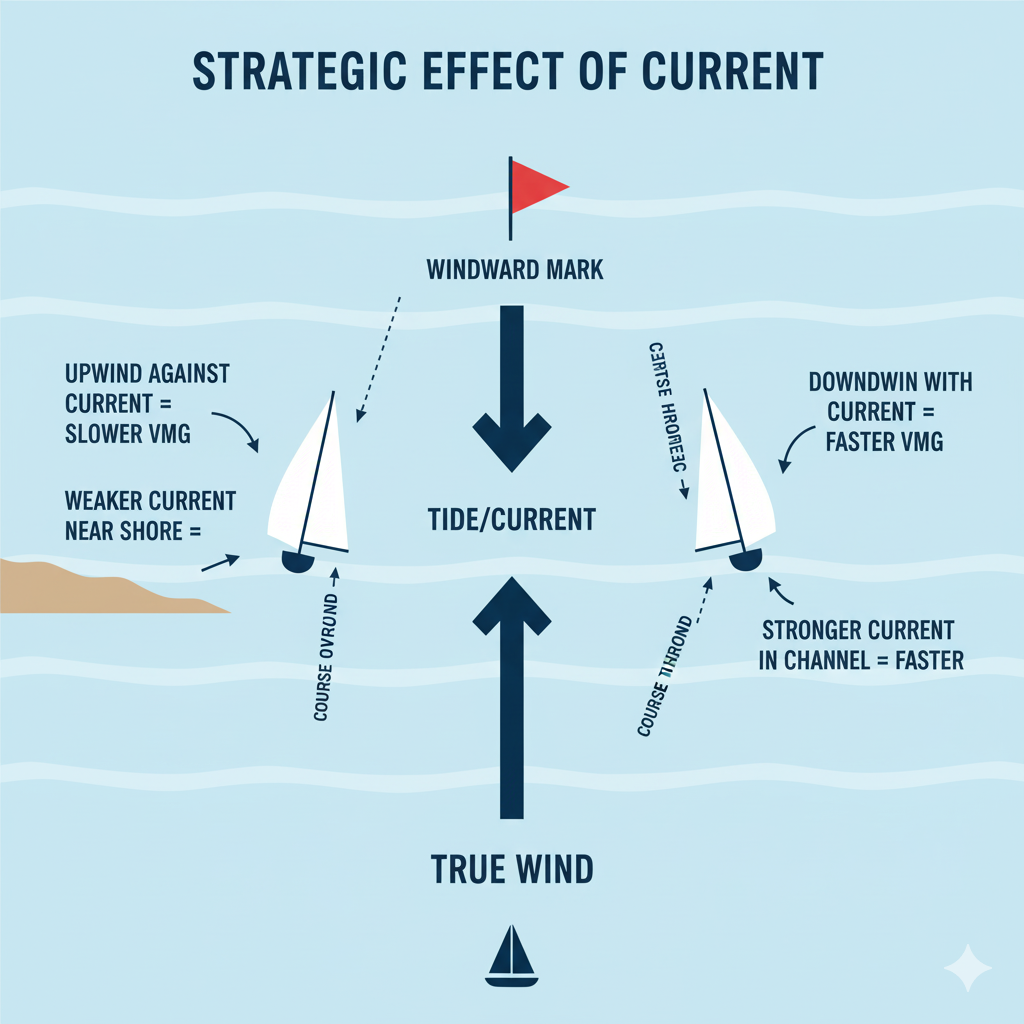
- Account for Current: Sail in weaker current when beating against tide. This often means favoring the shoreline in tidal waters.
- Don't Overstand Lay-line: Approach the windward mark on the starboard lay-line, but don't sail past it—you'll sail extra distance.
- Fleet Management: Avoid getting buried in large groups. Clear air and boat speed are more important than perfect positioning early on.
Subsequent Upwind Legs:
- Learn from First Beat: Apply lessons about wind shifts, current, and favored side from the first upwind leg.
- Cover if Ahead: If leading or in a good position, "cover" boats behind by staying between them and the next mark, matching their tacks.
- Split if Behind: If behind, don't follow the leaders. Split from the fleet and gamble on a different side of the course to gain positions.
- Wind Shifts: Continue to tack on headers and sail on lifts. Be aware if shifts are becoming more persistent or oscillating.
- Maintain Clear Air: Avoid being pinned to leeward or blanketed. Tack away early if necessary.
- Mark Approach: Plan your final approach to arrive at the windward mark on starboard tack with right of way and inside position if possible.
Downwind Leg Strategy:
- Sail the Angles: Don't sail dead downwind. Sail by the lee or on a broad reach, gybing downwind in a series of angles (often faster VMG to the leeward mark).
- Seek Pressure: Head toward areas of more wind. Downwind speed is all about wind pressure.
- Avoid Blankets: Stay out of wind shadows from boats ahead. Sail to the side if necessary to find clear air.
- Favorable Current: On downwind legs, position yourself in the strongest favorable current. This is the opposite strategy to upwind legs.
- Use Waves: In wave conditions, surf down waves by bearing away on the wave face and pumping the sail (within rule limits).
- Gybe on Lifts: Similar to tacking on headers upwind, gybe when the wind "lifts" you (allows you to head up) to stay on the favored gybe.
- Leeward Mark Approach: Plan your approach to round the leeward mark smoothly. Arrive on starboard gybe if possible for right of way. Avoid overstanding the lay-line.
Reaching Leg Strategy:
- Optimal Angle: Sail slightly high (closer to the wind) of the direct rhumb line to the mark. This gives you better speed and tactical options.
- Clear Air Priority: Get to windward of the fleet early to ensure clear, undisturbed wind. Windward position also lets you control boats to leeward.
- Speed and Trim: Focus on boat speed through optimal sail trim and balance. Small adjustments make big differences on a reach.
- Protect Inside at Mark: As you approach the reaching mark, position yourself for an inside overlap at the two-boat-length circle.
- Watch for Lifts/Headers: Wind shifts affect reaching legs too. Adjust your angle to take advantage of favorable shifts.
- Traffic Management: Avoid getting boxed in to leeward or trapped behind slower boats. Use your rights under the rules but sail conservatively to avoid penalties.
- Current Considerations: Factor in current pushing you toward or away from the mark, adjusting your course to compensate.
Starboard Tack Advantage Approaching Marks:
- Right of Way: Starboard tack has right of way over port tack. This gives you priority when approaching marks or in crossing situations.
- Windward Mark Strategy: Plan to approach the windward mark on starboard tack. Port tack boats must keep clear or tack away.
- Timing Your Approach: Tack onto starboard at the right moment—not too early (overstand the lay-line) or too late (have to tack again).
- Control the Fleet: Being on starboard gives you control. You can force port tack boats to alter course or tack.
- Inside Overlap: If approaching on starboard with an inside overlap, you have both right of way AND mark-room rights.
- Defensive Use: If ahead, approach on starboard to prevent boats behind from sneaking inside you on port.
- When Behind: Even when behind, approaching on starboard gives you opportunities. You can force boats ahead to tack away, potentially opening gaps.
Finish Line Bias and Strategy:
- What is Finish Line Bias?: Like the start line, one end of the finish line may be closer to the final mark, making it "favored."
- Identifying Bias (Theory): Stand at one end and sight along the line. The end that is further upwind on a windward finish (or further downwind on a leeward finish) is favored.
- Practical Challenge: At the Start Racing level, identifying bias while racing is difficult. Focus on crossing the line at the end closest to your current position.
- Final Approach Strategy: If finishing upwind, approach on starboard tack when possible. If finishing downwind, approach on starboard gybe.
- Don't Overshoot: Cross the line as soon as you can. Don't sail past the favored end—you'll sail extra distance.
- Clear Air to Finish: Ensure you have clear air in the final approach. Getting blanketed just before the finish can cost you positions.
- Know the Line: Be certain which direction to cross the finish line (usually the opposite direction to the start). Check the Sailing Instructions!
Race Boat Handling: Efficiency and The Five Essentials
All manoeuvres must be executed efficiently and with minimal loss of boat speed, maintaining control and good judgement.
Core Skills and Manoeuvres in Moderate Winds
- The 5 Essentials: You must consistently use 'The 5 Essentials' (Sail Setting, Boat Balance, Centreboard/Daggerboard Position, Course Made Good, and Trim) at all times.
- Manoeuvres: Demonstrate the sailing skills below in moderate winds, exercising good judgement and planning to conduct each manoeuvre in a seamanlike manner:
- Reach across the wind.
- Sail upwind.
- Sail downwind.
- Tack the boat.
- Gybe the boat.
- Heave-to.
- Catamaran Specific: Catamaran sailors must be confidently able to use a trapeze if the boat is equipped with one.
Racing Techniques in Detail
Mark Rounding (Wide In, Tight Out):
- Approach Wide: Start your turn 2-3 boat lengths before the mark to give yourself room and maintain speed through the turn.
- Turn Smoothly: Use the rudder progressively rather than harsh movements which slow the boat.
- Exit Tight: Aim to pass as close as safely possible to the mark on exit, positioning yourself for the optimal course on the next leg.
- Speed Through Turn: Keep the boat balanced and sails powered throughout. Ease the mainsheet slightly mid-turn if needed, but sheet in quickly as you exit.
- Crew Coordination: Crew should move smoothly across the boat, helping maintain balance without jerky movements that slow you down.
- Anticipate Traffic: Look ahead for boats on the new leg and plan your exit to get clear air.
Effective Racing Tack:
- Before the Tack: Build speed by sailing low for 2-3 seconds. Check behind and to leeward for clear space.
- Initiate Smoothly: Push the tiller steadily (not violently) while keeping the boat flat. Call "Ready about... lee-ho!"
- Through the Tack: Helm moves across early while boat is head-to-wind. Crew releases jib at last moment when it starts to back, crosses quickly but smoothly.
- Sheet In Fast: Pull both jib and main in quickly on the new tack. Delay = lost boat speed.
- Minimize Rudder: Once through the wind, straighten the tiller quickly. Excessive rudder acts as a brake.
- Accelerate: Bear away slightly (sail "low and fast") for 2-3 seconds after completing the tack to rebuild speed before heading up to close-hauled.
- Common Mistakes: Tacking too slowly (boat loses speed), over-steering (too much rudder), or not sheeting in fast enough on the new tack.
Effective Racing Gybe:
- Preparation: Build speed before the gybe. Check behind for boats. Call "Ready to gybe... gybe-ho!"
- Initiate Turn: Bear away smoothly. As the boat turns dead downwind, pull the mainsheet in quickly (but controlled) to bring the boom across.
- Cross the Boom: In light winds, physically pull the boom across. In stronger winds, sheet in most of the way and let it flip across with minimal force.
- Control the Boom: As the boom crosses centerline, ease the mainsheet out quickly but in a controlled manner to prevent the boom slamming across.
- Crew Movement: Crew should cross the boat smoothly, helping to keep it balanced. Avoid sudden weight shifts.
- Exit the Gybe: Once on the new gybe, head up slightly to optimal downwind angle and adjust sail trim.
- Safety: Keep your head low during the gybe to avoid being hit by the boom. Maintain balance throughout.
- Common Mistakes: Letting the boom crash across (loses control and speed), turning too sharply (can cause capsize), or poor weight distribution.
Identifying Upwind Lay-lines:
- What is a Lay-line?: The lay-line is the furthest line you can sail on one tack and still fetch (reach) the windward mark without tacking again.
- Why Important?: Sailing past the lay-line means you sail extra distance. Tacking too early means another tack is needed.
- Visual Method: Look at the mark and imagine a line extending from it at your boat's close-hauled angle (roughly 45° from the wind). You're on the lay-line when the mark is at this angle relative to your course.
- Practical Test: When approaching the mark, head up to close-hauled. If the mark is directly ahead or slightly to leeward, you're on or past the lay-line. If it's to windward, you need to sail further before tacking.
- Using Other Boats: Watch boats ahead on the same tack. If they tack and easily fetch the mark, you're near the lay-line.
- Account for: Current/tide (may push you sideways), wind shifts (can lift or head you), and boat leeway (sideways slip).
- Strategy: Avoid overstanding (sailing past the lay-line). Tack just inside the lay-line to arrive at the mark on starboard tack with right of way.
Overtaking on Reaches:
- Speed Difference: To overtake, you must sail faster than the boat ahead. This requires better boat handling, sail trim, or tactical positioning.
- Sail High and Fast: If you're faster, sail higher (closer to the wind) than the boat ahead. This gives you clear air and a better angle.
- Overtake to Windward: Pass to windward when possible. This gives you the tactical advantage and cleaner air. Once ahead, you can bear down and control their wind.
- Avoid Their Wind Shadow: If overtaking to leeward, ensure you get far enough ahead quickly to avoid their wind shadow blanking your sails.
- Use Waves: Skilled sailors can surf waves to gain extra speed bursts on reaching legs. Pump the sails (within rules) and use body movement to catch waves.
- Optimal Sailing Angle: Experiment with sailing angle. Sometimes sailing slightly higher maintains better speed and VMG (Velocity Made Good) toward the mark.
- Right of Way: Remember - windward boat keeps clear. If overtaking to windward, you must stay clear. If overtaking to leeward and establishing an overlap from behind, announce "water!" if approaching a mark within two boat lengths.
- Strategic Patience: Don't force a risky overtake. Wait for an opportunity when you have clear speed advantage or the boat ahead makes a mistake.
Weather & Coastal Knowledge: Environmental Factors
Understanding the race area environment is crucial for strategy.
Advanced Weather Awareness
- Forecast Sources: Identify and compare different sources for weather forecasts (e.g., online, radio, local knowledge).
- Local Effects: Describe what local weather effects (e.g., thermal breezes, land effects, funnelling) are likely to be present in the area and how these may affect your racing.
- Forecast Implications: Be able to identify the implications of the forecast weather on the race course (wind strength, direction changes, gusts, sea state) and plan tactics accordingly.
- Reading the Water: You must be able to identify wind shifts and gusts on the water by observing the surface and other boats.
Tidal Currents on the Race Course
- Current Mapping: Describe where there are likely to be stronger and weaker currents on a race area.
- Current Change: Understand how these currents may change during the day due to the tidal cycle and how this affects strategy for each leg.
What Next...
Upon successful completion, you can describe how to continue sailing, record progress in your logbook, and try another SBSS Advanced Module (such as Advanced Boat Handling, Adventure Skills, or Kites & Wires).
Remember to use The Irish Sailing Passport (powered by Checklick) as your online skills tracking, certification, and logbook system.
Further Guidance & Sports Knowledge
As you progress beyond Start Racing, focus on consolidating skills through regular race practice, coaching and targeted modules. Keep an up-to-date logbook of your training and race participation.
Classes of Boats Commonly Sailed in Ireland
Understanding different boat classes and their characteristics helps you appreciate the sailing community and potentially explore different types of racing:
Single-Handed Dinghies:
- Laser/ILCA: Single-handed, single sail dinghy. Three rig sizes (4.7, Radial, Standard). Simple, responsive, and popular for youth and adult racing. Excellent for developing boat handling skills.
- Topper: Lightweight single-hander, ideal for younger or lighter sailors. Features a single sail and is known for being user-friendly and fun.
- RS Aero: Modern single-hander with three rig options. Lighter and faster than Laser, becoming increasingly popular in Ireland.
Double-Handed Dinghies:
- 420: Two-person dinghy with mainsail, jib, and spinnaker. Popular training boat for developing crew work and advanced boat handling. Used extensively in youth racing.
- Mirror: Traditional, stable two-person dinghy with main and jib. Great for learning and family sailing. Simple rigging makes it accessible for beginners.
- GP14 (General Purpose 14): Versatile two-person dinghy, very popular in Irish club racing. Main and jib configuration, stable and forgiving.
- RS200: Modern, fast two-person dinghy with asymmetric spinnaker. Excellent for developing racing skills and crew coordination.
- Fireball: High-performance two-person dinghy requiring skill and athleticism. Main, jib, and spinnaker. Popular in competitive racing circuits.
Catamarans (Multihulls):
- Key Differences: Two hulls instead of one. Much faster than monohulls due to reduced drag. Wider beam provides stability but requires different balance techniques.
- Handling: No heeling—catamarans stay level or lift one hull ("flying a hull"). Weight placement is critical. Capsizing results in a turnover (boat inverted) rather than a simple side capsize.
- Common Classes: Hobie 16 (recreational and racing), Formula 18 (high-performance racing), Dart 18, Nacra 15/17.
- Rigging Differences: Often use fully battened mainsails, rotating masts, and trapezes for both helm and crew in racing configurations.
Keelboats and Cruiser-Racers:
- Key Differences: Fixed keel instead of centreboard, making them self-righting and more stable. Heavier and generally larger than dinghies.
- Handling: Slower to respond to helm and sail adjustments. More momentum means better planning for manoeuvres. Often raced with larger crews (4-8 people).
- Common Classes in Ireland: Squib (one-design keelboat), J24, Sigma 33, SB20 (modern sportsboat), and various IRC/ECHO-rated cruiser-racers.
- Rigging Differences: More complex sail inventory (multiple jibs, spinnakers, often genoas). More controls and adjustments (backstay, checkstays, cunningham, etc.).
Understanding Class-Specific Features:
- One-Design Classes: All boats in the class are identical (e.g., Laser, 420, Fireball). Racing emphasizes sailor skill rather than equipment differences.
- Handicap Racing: Different boat types race together using handicap systems (e.g., Portsmouth Yardstick, IRC, ECHO) to level performance differences.
- Local Variations: Check with your local sailing club to learn which classes are most popular in your area and which have active racing fleets.
Continuing Your Sailing Development
After completing Start Racing, here's how to continue building your skills and experience:
- Regular Race Practice: Join your local club's weekly racing series. Consistent practice is the best way to improve racing skills and confidence.
- Advanced Modules: Consider other ISA Small Boat Sailing Scheme modules such as:
- Advanced Boat Handling: Refine boat handling in challenging conditions.
- Kites & Wires: Learn to use spinnakers and trapezes.
- Adventure Skills: Develop navigation and expedition sailing skills.
- Coaching and Clinics: Attend racing clinics, coaching sessions, or training camps to receive expert feedback and accelerate improvement.
- Crew on Larger Boats: Gain experience by crewing on keelboats or larger racing yachts. This exposes you to different racing environments and team dynamics.
- Racing Roles: Volunteer as race committee crew or assist race officers. Understanding race management from the other side improves your racing awareness.
- Logbook Maintenance: Keep your logbook current in The Irish Sailing Passport. Record all racing, training hours, and skills development. This tracks your progress and is required for further certifications.
- Set Goals: Identify specific racing goals (e.g., top-3 finish in club series, compete in regional regatta, improve starts) and work systematically toward them.
- Learn from Others: Watch faster sailors, ask questions, and analyze race results. Sailing is a lifelong learning journey.
Logbook Requirements & Go Racing Option
Optional Go Racing log entries that support further certification and experience accumulation:
- Assist an ISA qualified Race Officer in running two (2) club races.
- Log participation in a minimum of six (6) club races as helm.
- Log participation in a minimum of six (6) club races as crew.
- Participate in at least one (1) interclub regatta consisting of a minimum of three (3) races.
Start Racing Quiz
Test your knowledge of the Racing Rules, signals, and start-line strategy with a quick quiz. Correct/incorrect answers will be highlighted instantly, and detailed AI feedback will follow.